


English for Meetings and Calls: Being Understood Without Repeating Yourself
Why calls flatten your English, the sounds and numbers that get misheard, and the fixed phrases for interrupting, clarifying and summarizing.
 How to Choose an Online English Tutor (A Checklist From a Tutor)10 min read
 How Much Does Accent Reduction Coaching Cost in 2026?9 min read
 Is Accent Reduction Worth It? What Actually Changes (and What Doesn't)9 min readAll articles
  Glottal T | 5 Minute American English Pronunciation PracticePractice video
 Flap T | 2 Minute American English Pronunciation PracticePractice video
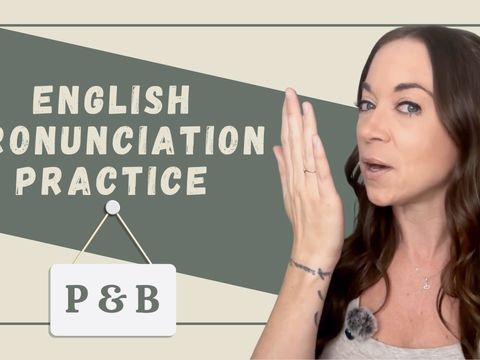 P vs B | 4 minute English Pronunciation PracticePractice videoAll videos
  Work with AshleyBook your first lesson50 minutes, one-on-one, $25. Live calendar in your timezone.Book now
By Ashley Curry · 10 min read · Updated August 7, 2026
Work with AshleyBook your first lesson50 minutes, one-on-one, $25. Live calendar in your timezone.Book now
By Ashley Curry · 10 min read · Updated August 7, 2026
Pat and bat, vine and wine, ice and eyes: each pair differs by one mouth movement, and each mix-up changes the meaning of your sentence. All three confusions come down to two skills you can test right now with your own hand and a sheet of paper.
P vs B pronunciation in English is about voicing and aspiration. B uses your voice: put a hand on your throat and you feel it buzz. P does not, and at the start of a word it comes with a puff of air strong enough to move a sheet of paper held in front of your mouth. V and W differ in the mouth shape: V presses the top teeth on the bottom lip, W rounds the lips and the teeth never touch. S and Z share one tongue position and differ only in voicing: S is air, Z is air plus buzz. Test each pair with the hand and the paper, and watch the ends of words, where most learners quietly lose the difference.
Voicing is whether your vocal cords vibrate while you make the sound. Put two fingers flat on your throat and say a long zzzzz. You feel a buzz. Now say a long sssss. Nothing. That buzz is the only difference between S and Z, and it is the same difference between these pairs: p/b, t/d, k/g, f/v, s/z, sh/zh, ch/j, and the two TH sounds. The first sound in each pair is voiceless, the second is voiced.
Aspiration is the puff of air that follows P, T and K at the start of a stressed syllable in English. Hold a sheet of paper an inch from your lips and say pie. The paper should jump. Say buy: it barely moves. This puff is not decoration. For an American listener, the puff is the main signal that says "P, not B" at the start of a word. That is why learners who carefully keep their P voiceless but skip the puff still get heard as saying bark instead of park.
One detail that surprises students: after an S, English P, T and K lose the puff. Spin, stop and skin have no aspiration. You do not need to add one, and adding one sounds odd.
Minimal pairs to test with the paper: pat/bat, pen/Ben, pig/big, pie/buy, pear/bear, pull/bull, pack/back, pest/best. For each P, the paper moves. For each B, your throat buzzes before your lips open, and the paper stays still.
At the end of a word the rules change, because Americans often do not release a final P or B at all. The lips close and stay closed. So how do listeners tell cap from cab, rope from robe, lap from lab, rip from rib? By the vowel. The vowel before a voiced consonant is noticeably longer. Cab is caaab; cap is short and clipped. If you say final B with a short vowel, Americans hear P. Stretch the vowel and the B arrives, even if your lips never open.
Who struggles most here: speakers of Arabic, where P does not exist as a separate sound, so parking becomes "barking" and Pepsi becomes "Bebsi". Korean speakers often produce a P that Americans hear as B, and the reverse.
Drill: say pay, bay, pay, bay with the paper. Then the sentence "Please put the big blue bag by the back porch." Every P should move the paper; every B should buzz first.
Pairs: vine/wine, vest/west, vet/wet, veil/whale, vary/wary, verse/worse, vow/wow. Say them in front of a mirror.
For V, your top front teeth rest on the inside of your bottom lip, your voice is on, and the sound can be held: vvvvv. You should be able to see your teeth in the mirror. For W, the lips push forward into a tight circle, as if you were about to say "oo", the teeth stay away from the lips entirely, and the sound is a quick glide into the next vowel. You cannot hold a W the way you hold a V. Mirror test: teeth visible means V; round lips and no teeth means W.
Which direction the error goes depends on your first language. German, Dutch, Polish, Russian and Ukrainian speakers usually replace W with V: "ve vill" for "we will", "vine" for "wine". The fix is lip rounding: exaggerate the "oo" shape before every W for a week. Hindi, Urdu and Punjabi speakers have one sound between the two, so the swap goes both ways and needs the mirror. Mandarin and Japanese speakers often turn V into W or B, because V does not exist in either language: very becomes "wery" or "bery". The fix is the teeth. If the top teeth touch the lip, it cannot be W or B.
Spanish and Portuguese speakers have a different problem: V becomes B, so vote sounds like boat, very like berry, van like ban. Same fix. B closes the lips together; V never lets the lips touch each other, only the teeth touch the lip.
Drill sentence: "We've visited Vienna twice, and we will visit Warsaw in winter." Watch your teeth in the mirror on every V and your lips on every W.
Pairs: ice/eyes, price/prize, bus/buzz, Sue/zoo, race/raise, peace/peas, rice/rise, loose/lose. Say each pair with a hand on your throat. The second word buzzes; the first does not. Nothing else changes.
The trap here is spelling. English writes hundreds of Z sounds with the letter S. These everyday words all have z, not s: is, was, has, does, his, these, those, because, easy, busy, please, music, visit, reason, present, cousin, always.
The ending rule is the one that matters most, because it touches every plural and every "he/she/it" verb:
| Sound before the -s | The -s becomes | Examples |
|---|---|---|
| voiceless (p, t, k, f, th) | s | cats, books, stops, laughs, walks |
| voiced (b, d, g, v, m, n, l, r, any vowel) | z | dogs, days, runs, loves, calls, goes |
| s, z, sh, ch, j | iz | buses, prizes, wishes, watches, judges |
One pair that costs money: price and prize. "What's the prize?" in a sales call gets a confused look. Vowel length helps you here too, exactly as with cap and cab: prize has the longer vowel.
If your first language is German, Dutch, Russian, Polish, Turkish, Czech or Catalan, the biggest issue is probably not P vs B at the start of words. It is that your language switches every final consonant to voiceless, so bad becomes bat, dog becomes dock, have becomes half, leave becomes leaf, eyes becomes ice, and cab becomes cap.
English does not switch the voice off. The final consonant may be quiet, but the vowel before it stays long. So the fix is not "buzz harder at the end". It is "stretch the vowel before B, D, G, V, Z". Say bad as baaad, bat short. Say leave as leeeave, leaf short. Record both and listen for the length, not the consonant.
Practice pairs: bad/bat, had/hat, need/neat, dog/dock, bag/back, save/safe, believe/belief, eyes/ice, buzz/bus, cab/cap. The vowel sounds themselves also carry a lot of the load in English, so once the length is under control, my guide to the vowel pairs that cause the most misunderstandings is the natural next step.
Most students need one pair, sometimes two. This is what I usually see in first lessons; the recording routine below tells you whether it matches you.
| First language | Start here | Typical swap | One test |
|---|---|---|---|
| Spanish, Portuguese | V vs B, then S vs Z | very to "berry", eyes to "ice" | mirror: teeth on lip for V |
| German, Dutch | final voicing, then V vs W | bad to "bat", we to "ve" | vowel length before final D, G, V, Z |
| Polish, Russian, Ukrainian | V vs W, final voicing | wine to "vine", dog to "dock" | lip rounding before every W |
| Arabic | P vs B | park to "bark" | paper must move on every P |
| Korean | P vs B, then S vs Z | both directions | paper for P, throat buzz for B and Z |
| Japanese | V vs B, S vs Z | very to "bery" | teeth on lip; lips never close for V |
| Mandarin, Cantonese | V vs W, final consonants | very to "wery", dropped final Z | hold a long vvvv before each V word |
| Hindi, Urdu, Punjabi | V vs W | both directions | mirror on every V and W |
Other sounds that are not on this page, such as the two TH sounds and the American R, have their own guides: how to pronounce TH and the American R.
Write ten minimal pairs from this page on a card, mixing all three families. Record yourself reading them in random order, one word at a time, without saying which is which. Wait a day. Play the recording and write down which word you hear each time. Then compare with the card.
If you scored ten out of ten, either the pair is fine or your ear is forgiving you. This is the honest limit of self-study: you judge your recording with the same ear that produced the sound. In lessons I do the same test live. I say a pair, the student repeats it, and I tell them which word I heard. Ten rounds of that usually finds the real problem in minutes, and students like Luca and Cesar tell me that kind of plain feedback was what they had been missing. Between lessons, the routines in how to practice speaking alone keep the new habit moving.
If the recording test is inconclusive, book a first lesson and we run it live: 50 minutes, $25, and you leave knowing exactly which pair is yours. Packs and monthly plans are in the pricing section.
B is voiced (your throat buzzes) and P is voiceless with a puff of air at the start of a word. At the end of a word the clearest signal is vowel length: the vowel before B (cab, robe) is longer than the vowel before P (cap, rope).
Because at the start of a word Americans rely on the puff of air more than on voicing. A P without aspiration sounds like B to them even if your vocal cords are silent. Hold a sheet of paper in front of your mouth and make it move on every initial P.
Between vowels and at the end of words after a voiced sound, S is usually z: is, was, has, easy, music, dogs, plays. After a voiceless sound it stays s: cats, stops. When in doubt, say the word slowly with a hand on your throat and let your mouth pick the easier option.
Usually context saves you, but pairs like vest/west, vine/wine and vary/wary do cause real confusion, and a consistent V-for-W pattern is one of the strongest accent markers for German and Slavic speakers. It is also one of the fastest to fix, because the difference is visible in a mirror.
German switches every final consonant to voiceless, and you carry that habit into English. The fix is not to buzz harder at the end but to lengthen the vowel: baaad with a long vowel, bat with a short one. Americans use that length to tell the two apart.

Why calls flatten your English, the sounds and numbers that get misheard, and the fixed phrases for interrupting, clarifying and summarizing.
The ten moves of American small talk: how to answer 'how's it going', safe topics, real phrases like my bad and no way, moving intonation, and a graceful exit.
The four IELTS Speaking criteria in plain language, why Band 6 candidates plateau on fluency and pronunciation, Part 1 to 3 strategies, and a four-week plan.
Private American English coaching with Ashley Curry: pronunciation, accent and confidence, built around your goals.