


How Many English Lessons a Week Do You Really Need?
One lesson a week maintains, two changes an accent, three is for a deadline, and the days between lessons decide the result.
 How to Choose an Online English Tutor (A Checklist From a Tutor)10 min read
 How Much Does Accent Reduction Coaching Cost in 2026?9 min read
 Is Accent Reduction Worth It? What Actually Changes (and What Doesn't)9 min readAll articles
  Glottal T | 5 Minute American English Pronunciation PracticePractice video
 Flap T | 2 Minute American English Pronunciation PracticePractice video
 P vs B | 4 minute English Pronunciation PracticePractice videoAll videos
  Work with AshleyBook your first lesson50 minutes, one-on-one, $25. Live calendar in your timezone.Book now
By Ashley Curry · 10 min read · Updated August 21, 2026
Work with AshleyBook your first lesson50 minutes, one-on-one, $25. Live calendar in your timezone.Book now
By Ashley Curry · 10 min read · Updated August 21, 2026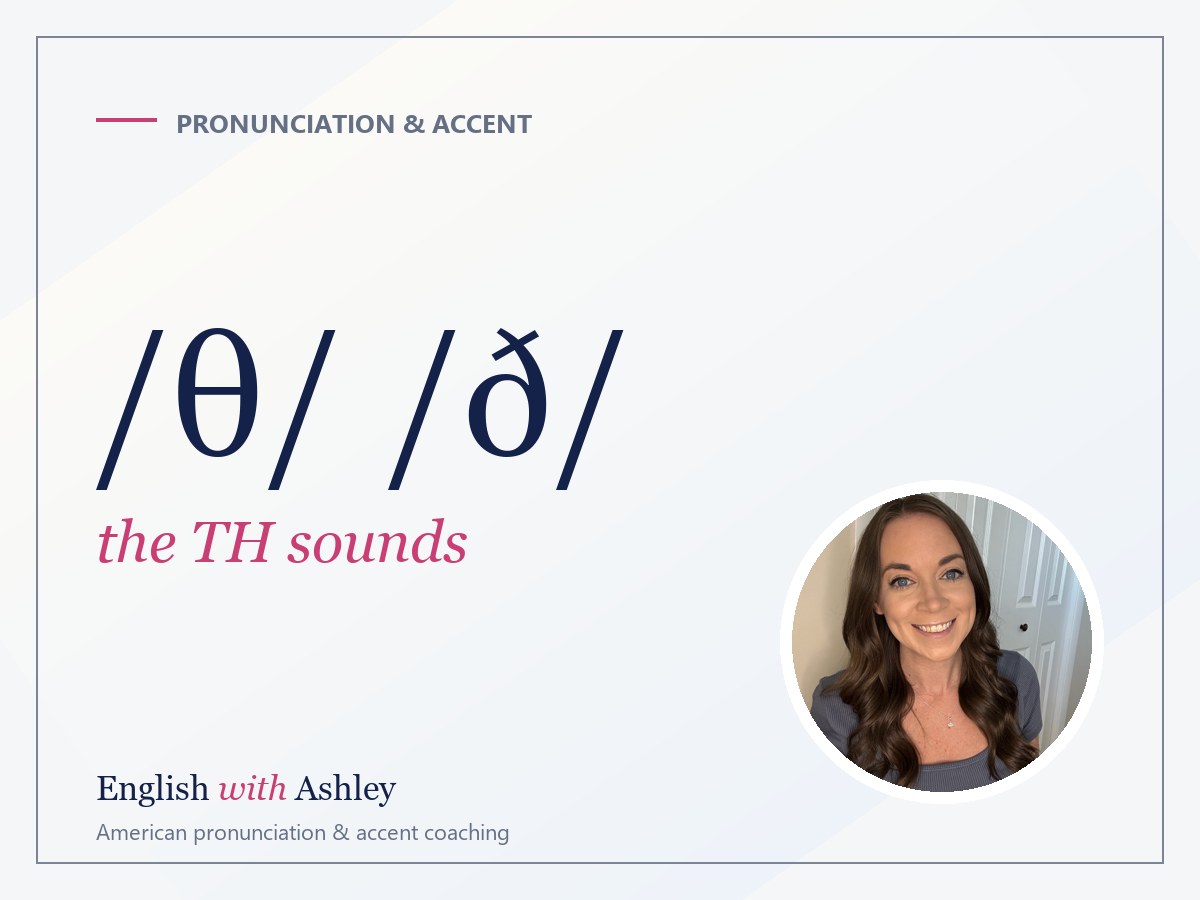
TH is the sound my students ask about more than any other, and almost all of them are making the same two errors: the tongue is hiding behind the teeth, and they are treating think and this as the same sound. Fix those two things and TH stops being a problem in a few weeks. Here is how to pronounce TH in English, both sounds, in every position.
English has two TH sounds with one spelling. The voiceless /θ/ in think, three, bath and month is air only, no voice. The voiced /ð/ in this, they, mother and breathe adds vibration from the vocal cords. For both, the tip of your tongue touches the bottom edge of your top front teeth, or sits lightly between the teeth, and air passes over it. The tongue must be visible in a mirror. If it is behind the teeth you will produce T, D, S or Z instead. Learn the position first, then practice each sound at the start, middle and end of words, because the end position (bath, months, both) is where even advanced speakers still slip.
Before any tongue work, you need to know which TH you are aiming for, because the spelling gives you no help. Put your fingers on your throat and say a long ssss, then a long zzzz. You feel vibration on Z and none on S. TH has the same pair.
| Position | Voiceless /θ/ (no vibration) | Voiced /ð/ (vibration) |
|---|---|---|
| Start of word | think, three, thank, thing, thumb, Thursday, thousand | this, that, the, they, them, there, though |
| Middle | author, method, healthy, nothing, athlete | mother, father, brother, weather, either, other |
| End | bath, month, both, tooth, north, breath | breathe, bathe, smooth, with (often), clothe |
There is a useful shortcut. Almost every grammar word that starts with TH is voiced: the, this, that, these, those, they, them, their, there, then, than, though. Almost every content word (nouns, verbs, adjectives) that starts with TH is voiceless: think, thing, three, thick, thin, throw, thread. It is not a perfect rule, but it covers what you say in a normal day.
Voiced TH is far more frequent in speech than voiceless, simply because the and that are everywhere. So if you only have time to fix one, fix /ð/.
Here is the physical part. Open your mouth a little. Push the tip of your tongue forward until it touches the bottom edge of your top front teeth. A small part of the tongue, a few millimeters, should be visible if you look in a mirror. Now blow air gently over the tongue. That is /θ/. Add voice and it is /ð/.
The problem is not that this is hard. The problem is that it feels rude. In most languages the tongue never leaves the mouth during speech, and my students tell me they feel like they are sticking their tongue out at me. So they compromise: the tongue goes to the back of the teeth, air squeezes past, and out comes an S or a T.
My advice in lessons is to exaggerate for two weeks. Put the tongue further out than you think is necessary. Nobody notices a TH tongue in real conversation, and once the muscle memory is there you can pull it back to a natural position. Students who try to be subtle from day one usually stay stuck.
Two checks that tell you the position is right:
Every learner replaces TH with the closest sound from home, and the replacement tells me where you are from before you tell me. Knowing your own substitute matters, because you need to hear it before you can stop it.
| Substitute | Typical first languages | What "three things" becomes |
|---|---|---|
| T and D | French, Italian, Portuguese, Hindi, Urdu, Vietnamese, many others | tree tings, and dis for this |
| S and Z | German, Japanese, Korean, Chinese, Turkish | sree sings, and zis for this |
| F and V | Some Chinese speakers, some British regional accents | free fings, and vis for this |
The T/D substitution is the most dangerous because it creates real words: three becomes tree, thank becomes tank, they becomes day, breathe becomes breed. The listener does not hear an accent, they hear a different word and have to work out the meaning from context. Students like Luca and Cesar tell me that being asked to repeat "three" in a shop was the moment they decided to fix it.
The S/Z substitution is less likely to change meaning but is very noticeable, especially in think, which comes out as sink. Learning German gave me sympathy here: German has no TH at all, and the S substitute is automatic for German speakers.
If you also mix up other consonant pairs, the same voicing test applies, and I cover those in P vs B, V vs W, S vs Z.
Start-of-word TH is the easiest position, because you have time to place the tongue before the word begins. Practice in pairs so your ear learns the contrast, not just your mouth.
| TH | T / D | S / Z | F / V |
|---|---|---|---|
| three | tree | (none) | free |
| think | tink | sink | fink |
| thank | tank | sank | (none) |
| thin | tin | sin | fin |
| thought | taught | sought | fought |
| they | day | (none) | (none) |
| then | den | Zen | (none) |
| those | doze | (none) | (none) |
Use the column that matches your substitute. Say the pair slowly, TH first, then the other word, and make the tongue go out for the first and stay in for the second. Ten pairs, three times each, is a two-minute exercise.
The cluster thr deserves extra time. Three, throw, through, thread, threat, thrive. The tongue has to go out for TH and then pull back fast for R. Slow it down to th... ree with a small gap, then close the gap over several repetitions.
Most students get start-of-word TH within a couple of weeks. The end position takes longer, because at the end of a word your attention has already moved to the next word and the tongue takes the shortcut.
Middle position: mother, father, brother, another, weather, either, nothing, something, anything, birthday, healthy. The trick is to slow down the syllable before TH and let the tongue arrive. Birthday is a favorite in my lessons because TH comes right before D, so your tongue goes out for TH and then straight to the ridge behind the teeth for D. Say birth, pause, day, then join them.
End position: bath, both, month, tooth, teeth, north, south, mouth, breath, with, smooth, breathe. Say the word, and hold the TH for a full second at the end. Baaaath-th-th. That feels silly, but it forces the tongue out. Then shorten it.
End position plus S: this is the hardest thing in the whole article. Months, clothes, baths, breathes, sixths. The tongue must go from between the teeth (TH) to behind the teeth (S) in a fraction of a second. Two honest pieces of advice:
munths with a very light TH. Aim for a quick touch of the tongue, not a full TH, and move to S.kloʊz). Trying to pronounce the TH here makes you sound less natural, not more.A related pair that catches people is bath (noun, voiceless, short vowel) and bathe (verb, voiced, long vowel). Same with breath and breathe, cloth and clothe. The final E in the spelling is your signal that the TH is voiced.
A short list, because spelling is not your friend here.
AZ-muh, no TH sound at all.IS-mus.eytth.If words like these interest you, I keep a longer list of spelling traps in silent letters and sneaky spellings.
Consistency beats intensity. Ten minutes a day for three weeks does more than an hour on Sunday.
/θ/ sounds, tongue visible, then twenty /ð/ with your hand on your throat feeling the vibration.The recording step is the one everyone skips and the one that matters most. You cannot fix what you cannot hear. In lessons, this is where I earn my keep: I stop you on the exact word, play it back, and show you the substitute you did not notice. Students often tell me the first time they heard their own sink for think was the first time it started to change.
Do the routine above every day. Use the mirror on days one to three even if it feels unnecessary. On day seven, record the same paragraph you recorded on day one and compare. Most people hear a clear difference at the start of words and a smaller one at the end. That is normal; ends take another two weeks.
If you want your substitute diagnosed properly and a word list built around the TH words you actually use at work, book a first lesson. You can read how a pronunciation lesson is structured in this minute-by-minute breakdown, and prices are in the pricing section.
You do not need it between the teeth. Touching the bottom edge of the top front teeth from the inside is enough, as long as air passes over the tongue tip. Between the teeth is a teaching exaggeration that helps at the start. Once the sound is stable you can pull the tongue back to just behind the edge of the teeth.
For understanding, usually not: dis and dat are understood from context. For how you sound, yes, because the and that appear in almost every sentence, so the substitute is heard constantly. It is one of the most frequent markers of a non-native accent, which is why I prioritize voiced TH over voiceless.
In fast speech the final TH in with weakens, and in some regional accents it becomes a T or D. Standard General American keeps a light TH. As a learner, aim for the TH; reducing it is something you can allow later once the full sound is easy.
No. Nearly all native speakers say clothes exactly like close (rhymes with nose). Pronouncing a clear TH plus Z is possible but sounds effortful. Save your TH energy for months and both, where it is heard.
Start-of-word TH usually becomes reliable within two to three weeks of daily practice. End-of-word TH and the thr cluster take four to six weeks. Fully automatic in fast, emotional conversation can take a few months, and the fastest way there is regular feedback from someone who catches the slips you cannot hear.
One lesson a week maintains, two changes an accent, three is for a deadline, and the days between lessons decide the result.
What changes in one month, three months and a year of accent work, and the three factors that decide which timeline is yours.
The three-pass shadowing routine I give every student, the audio that works, and the four mistakes that make shadowing useless.
Private American English coaching with Ashley Curry: pronunciation, accent and confidence, built around your goals.