
Stuck at B2? How to Break the Intermediate English Plateau
The four habits that keep adults stuck at B2 for years, and a weekly plan that replaces each one with something that moves you.
 How to Choose an Online English Tutor (A Checklist From a Tutor)10 min read
 How Much Does Accent Reduction Coaching Cost in 2026?9 min read
 Is Accent Reduction Worth It? What Actually Changes (and What Doesn't)9 min readAll articles
  Glottal T | 5 Minute American English Pronunciation PracticePractice video
 Flap T | 2 Minute American English Pronunciation PracticePractice video
 P vs B | 4 minute English Pronunciation PracticePractice videoAll videos
  Work with AshleyBook your first lesson50 minutes, one-on-one, $25. Live calendar in your timezone.Book now
By Ashley Curry · 10 min read · Updated August 19, 2026
Work with AshleyBook your first lesson50 minutes, one-on-one, $25. Live calendar in your timezone.Book now
By Ashley Curry · 10 min read · Updated August 19, 2026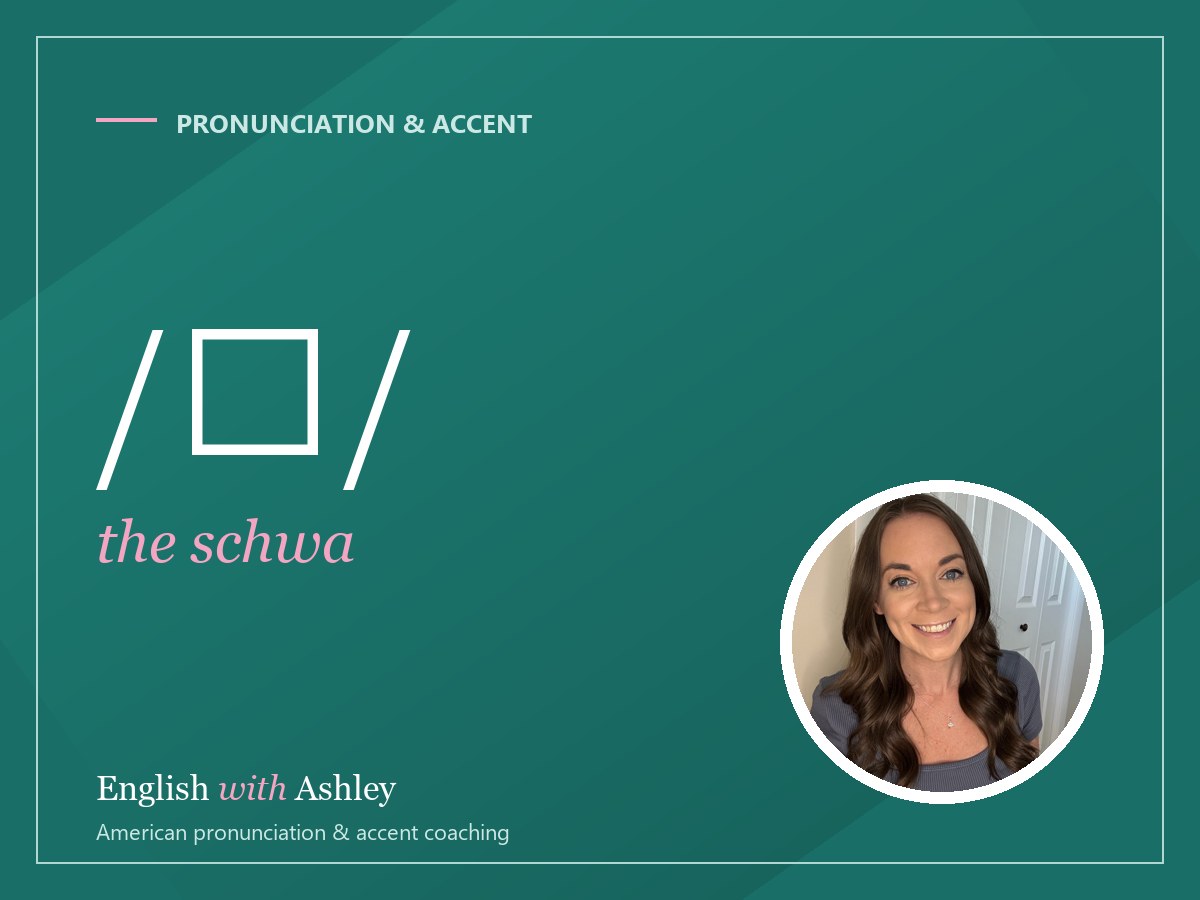
The schwa is the vowel in the first syllable of about, the second of problem and the last of sofa. It is the most common vowel sound in English, it can be spelled with any vowel letter, and most learners have never been taught it. That is why their English sounds careful and slow when they want it to sound clear and relaxed.
The schwa sound in English, written /ə/, is a short, relaxed uh. Your mouth is neutral: jaw slightly open, tongue resting in the middle, lips not rounded, no effort. It appears only in unstressed syllables and it replaces whatever vowel the spelling shows: the a in about, the e in problem, the o in today, the u in support. It is also the vowel in most small grammar words when they are not stressed: a, the, to, of, for, can, and. To find it in any word, find the stressed syllable first; most of the other vowels are schwa or very close to it. Using it correctly makes you clearer, because English listeners locate the stressed syllable by contrast with the weak ones around it.
Make the sound you make when you are thinking of what to say: uh. Not a long, low ahh. A short, quiet, lazy uh with your face completely relaxed. That is the schwa. It is the sound your mouth makes when it is not trying to make any sound in particular.
Two physical rules. First, it is short. Shorter than any other vowel. If you can hold it, you are making it too long. Second, it is quiet. It never carries stress, so it is never louder or higher than the syllables around it.
Listen to a native speaker say banana. There is one clear vowel, in the middle: buh-NA-nuh. The first and last syllables are both schwa, even though they are both spelled with the letter A, the same letter as the stressed middle. Spanish, Italian, Japanese and most other languages would give all three syllables a full, clear A. English gives one syllable a full vowel and squashes the other two.
This is the part that makes the schwa invisible to learners. There is no letter for it. English spelling shows you A, E, I, O or U, and you pronounce what you see. But in an unstressed syllable, all five letters often collapse into the same uh.
| Letter | Words | What you hear |
|---|---|---|
| A | about, sofa, banana, again | uh-BOUT, SO-fuh |
| E | problem, taken, system, open | PROB-luhm, SIS-tuhm |
| I | pencil, family, possible, easily | PEN-suhl, FAM-uh-lee |
| O | today, police, memory, purpose | tuh-DAY, puh-LEES |
| U | support, supply, focus, campus | suh-PORT, FO-kuhs |
| combinations | famous, nation, ocean, parliament | FAY-muhs, NAY-shuhn |
Three words from my video catalog that students mispronounce for exactly this reason: especially is uh-SPESH-uh-lee (schwa, stress, schwa, ee), not es-pe-shal-ly with four clear vowels. Essentially is uh-SEN-shuh-lee. Chocolate is CHOK-luht, two syllables, the middle O gone completely. If you say especially with a full E at the start, every American hears it, and it is a small thing that makes an otherwise excellent speaker sound non-native. It is on my list of words advanced learners still mispronounce for that reason.
You cannot find the schwa by looking at the spelling. You find it by finding the stress. Here is the method I teach in the first lesson on this sound.
/pəˈteɪtoʊ/. Or hum the word. The syllable your hum goes up on is the stressed one.uh. Not all of them will become a pure schwa. Some keep a short ih or a short ee, especially near the end of the word. But the direction is always toward relaxation and away from a clear vowel.Try it with photograph, photographer, photographic. Same root, three different stress positions, and the schwa moves each time: FO-tuh-graf, fuh-TOG-ruh-fer, fo-tuh-GRAF-ik. The O in the first syllable is a full oh in the first word and a schwa in the second. The spelling did not change. The stress did.
This is why I never teach the schwa on its own. It is the shadow of stress, and if you do not know where the stress falls you cannot place the schwa. If word stress is not solid for you yet, read my guide to word stress first and come back to this one.
Inside words, the schwa is common. Between words, it is everywhere. The small grammar words of English, prepositions, articles, auxiliaries and conjunctions, are almost always unstressed in a sentence, and when they are unstressed their vowel becomes schwa.
| Word | Careful (alone) | In a sentence (schwa) | Example |
|---|---|---|---|
| to | too | tuh | I want to go: wan-tuh go |
| a / an | ay | uh | a cup of coffee: uh cup uh coffee |
| the | thee | thuh | the meeting |
| of | ov | uh / uhv | a lot of people: uh lot uh people |
| for | for | fer | this is for you |
| can | kan | kuhn | I can do it: I kuhn do it |
| and | and | uhn / n | salt and pepper: salt n pepper |
| was | wahz | wuhz | she was late |
Two of these matter more than the rest. Can is the big one: Americans say kuhn in a normal sentence and save the full vowel for can't, which is how they tell the two apart. If you give can its full vowel, you sound like you are saying can't. I have a whole article on can vs can't because it causes real misunderstandings at work.
To is the other. wan-tuh, going tuh, have tuh. Say to as too every time and your sentences sound like a language app reading aloud. This is also the origin of wanna and gonna: they are just want to and going to with the schwa doing its job. The mechanics of that are in connected speech.
This is the counterintuitive part. Students assume that pronouncing every vowel clearly makes them clearer. In English it does the opposite.
English listeners find the meaning of a sentence by locating the stressed syllables. They can only do that if the stressed syllables stand out, and they can only stand out if the syllables around them are weak. Take the schwa away and every syllable has the same weight. The listener hears a flat line of equal syllables, cannot find the stress, and has to work harder to catch the words. That is why a speaker with perfect consonants and full vowels in every syllable can still be tiring to listen to.
There is a second effect. A sentence with schwas is faster, not because the speaker talks fast, but because the weak syllables take almost no time. I was going to ask you about the report has eleven syllables, and in natural speech only three or four carry real weight: I wuhz GON-nuh ASK yuh uh-bout thuh re-PORT. Speakers who give every syllable a full vowel take much longer to say it and sound like they are reading. That also explains why native speech feels so fast when you listen; I go into that in why Americans seem to talk fast.
Students like Sara and Olivia, who were already fluent when they started with me, often say this was the change that made people stop asking them to repeat things. Not a new consonant. Just letting the weak syllables be weak.
Not enough schwa. This is the default for almost every learner. Every vowel gets its spelling value. Today becomes too-day, support becomes soo-port, police becomes po-lees. The fix is the stress-first method above, applied word by word to the vocabulary you use most.
Schwa in the wrong place. Less common, but I hear it in students who have read about reduction and started reducing everything. The stressed syllable must keep its full vowel. Record the noun is REK-erd; reduce the first syllable and it becomes the verb ruh-KORD, a different word. Reduce a stressed syllable and you do not sound relaxed, you sound unclear. The schwa lives in weak syllables only.
A third, smaller issue: some students make the schwa too long or too low, closer to the ah in father. Keep it short and central. If you can sing it, it is too long.
uh, twenty times. Then uh-BOUT, uh-GAIN, uh-LONE, feeling the jump from weak to strong.MAN-uh-jer. Analysis is uh-NAL-uh-sis. Development is duh-VEL-uhp-muhnt. If your field is business, start with the words you say in every meeting.I wan-tuh talk tuh yuh fer uh minute uh-bout thuh plan. Slowly first, then at normal speed.Choose the three grammar words you say most: for almost everyone that is to, can and a. Reduce them to schwa every time you speak English this week. It will feel sloppy. It is not; it is how every native speaker around you talks. At the end of the week, record yourself telling a one-minute story and listen for those three words only.
The hard part of the schwa is that you cannot hear your own missing reductions; your ear was trained on your own careful speech. If you want someone to mark exactly which syllables you are over-pronouncing and give you a word list built from your own vocabulary, book a first lesson. Lesson packages and monthly plans are in the pricing section.
It is the short, relaxed uh that English uses for most unstressed syllables, spelled with any vowel letter, as in the first syllable of about or the last syllable of problem. It is the most common vowel sound in the language.
Find the stress first. The stressed syllable never has a schwa. The unstressed syllables usually do, especially in longer words and in grammar words inside a sentence. A dictionary with phonetic spelling shows it as ə. When in doubt, relax the syllable; a slightly over-reduced weak syllable sounds far more natural than a clear one.
No. It is standard in every register of American English, from a job interview to a news broadcast. Not using it is what sounds unusual. The only time native speakers give a grammar word its full vowel is for emphasis or contrast: "I said a report, not the report."
Yes, and just as often. Both accents reduce unstressed syllables to schwa. The main difference is that in American English the schwa before an R becomes an R-colored sound (teacher ends in er), while British English drops the R and keeps a plain schwa.
Because it is short, quiet and unstressed, and your ear was trained to expect the vowel the spelling shows. Once you know that to is tuh and especially starts with uh, you start hearing them everywhere. Most of my students say listening gets noticeably easier within a week or two of learning the schwa, because they stop waiting for vowels that are not there.
The four habits that keep adults stuck at B2 for years, and a weekly plan that replaces each one with something that moves you.
Why confident speakers are not braver than you, what actually removes the fear, and a four-week plan of low-stakes reps, scripts and clearer sounds.
ChatGPT is excellent for writing, vocabulary and role-play scripts, and useless for your vowels. Here is how to split the work between AI and a human.
Private American English coaching with Ashley Curry: pronunciation, accent and confidence, built around your goals.