
English for Meetings and Calls: Being Understood Without Repeating Yourself
Why calls flatten your English, the sounds and numbers that get misheard, and the fixed phrases for interrupting, clarifying and summarizing.
 How to Choose an Online English Tutor (A Checklist From a Tutor)10 min read
 How Much Does Accent Reduction Coaching Cost in 2026?9 min read
 Is Accent Reduction Worth It? What Actually Changes (and What Doesn't)9 min readAll articles
  Glottal T | 5 Minute American English Pronunciation PracticePractice video
 Flap T | 2 Minute American English Pronunciation PracticePractice video
 P vs B | 4 minute English Pronunciation PracticePractice videoAll videos
  Work with AshleyBook your first lesson50 minutes, one-on-one, $25. Live calendar in your timezone.Book now
By Ashley Curry · 8 min read · Updated August 8, 2026
Work with AshleyBook your first lesson50 minutes, one-on-one, $25. Live calendar in your timezone.Book now
By Ashley Curry · 8 min read · Updated August 8, 2026
These are the 25 words I correct most often with upper-intermediate and advanced students, sorted by the mistake behind them. For each one you get the version you probably say, the version Americans say, and the reason, so the fix carries over to other words with the same trap.
The most mispronounced English words at B2 and above are rarely difficult words. They are everyday words with a trap inside: stress on the wrong syllable (decade, economy, develop), a syllable that should disappear (comfortable, business, clothes), a silent letter (salmon, receipt, debt), a vowel that ignores the spelling (southern, foreign, ancient), or a TH that never got fixed (though, thought, through). Learn the five traps and you repair far more than 25 words.
Almost every error on this list comes from reading. You met the word on a page before you heard it, your brain assigned a pronunciation based on the letters, and nobody corrected it because everyone understood you anyway. By B2 your colleagues are too polite to interrupt, and your listening brain filters the native version through what you expect to hear. The error settles in and becomes automatic.
The cost is not comprehension. It is the half-second pause in the listener's head when decade comes out as "de-KADE", the small flag that says "not from here" in the middle of an otherwise fluent sentence. In meetings those flags add up, which is why I also keep a separate list of business words professionals mispronounce. Here, the list is broader: the words that come up in any conversation.
In the tables, the "You probably say" column is what I hear most in first lessons. The "Say" column uses simple respelling with the stressed syllable in capitals.
Native listeners recognize a word by its stress shape before they process its individual sounds. Put the weight on the wrong syllable and every consonant can be perfect while the word still sounds off.
| # | Word | You probably say | Say | Note |
|---|---|---|---|---|
| 1 | decade | de-KADE | DEK-ayd | Stress on the first syllable; rhymes with "wreck aid". |
| 2 | economy | EE-ko-no-mee | ih-KON-uh-mee | Stress moves in economic: ek-uh-NOM-ik. |
| 3 | develop | DEV-uh-lop | dih-VEL-up | Same in development: dih-VEL-up-munt. |
| 4 | hotel | HO-tel | ho-TEL | Second syllable, always. |
| 5 | colleague | ko-LEEG | KOL-eeg | Two syllables, first one stressed; the "ue" is silent. |
| 6 | unique | YOO-nik | yoo-NEEK | Second syllable, long "ee". |
| 7 | reciprocate | re-si-pro-KATE | rih-SIP-ruh-kate | Stress on "SIP"; the first and third vowels shrink. |
The pattern to take away: when a word has three or more syllables, look for the stressed one first and let the others shrink. If finding the stressed syllable feels like guessing, my guide to word stress in English gives you the rules that cover most cases.
English drops and squashes unstressed syllables. Learners who pronounce every written vowel sound careful and slow, and native listeners have to wait for the word to finish.
| # | Word | You probably say | Say | Note |
|---|---|---|---|---|
| 8 | comfortable | com-for-TA-ble | KUMF-ter-bul | Three syllables. The "or" almost vanishes and the T jumps in front of it. |
| 9 | vegetable | ve-ge-TA-ble | VEJ-tuh-bul | Three syllables; the second E is gone. |
| 10 | business | BIZ-i-ness | BIZ-nis | Two syllables. The middle I does not exist in speech. |
| 11 | especially | ex-PESH-uh-lee | ih-SPESH-uh-lee | There is no X. It starts like "is". |
| 12 | essentially | es-sen-shee-AL-lee | ih-SEN-shuh-lee | Four syllables, and "-tial" is shul, not "shee-ul". |
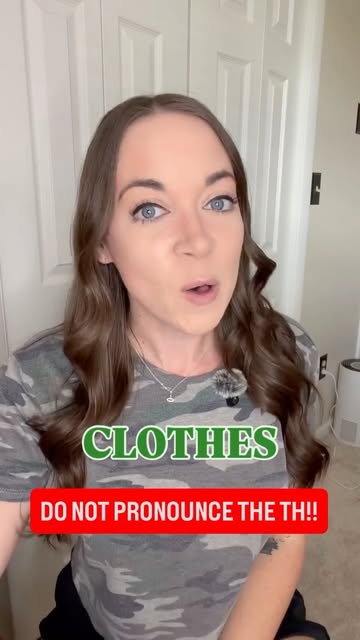
| 13 | clothes | CLO-thez / CLO-ziz | KLOZE | One syllable. It sounds exactly like the verb "close". |
Those shrinking vowels are all the same sound, the weak schwa. Once you can hear it, comfortable and vegetable stop feeling like exceptions and start feeling like the normal English rhythm.
Spelling in English preserves letters that stopped being pronounced centuries ago, or that were added by scholars to show Latin roots. Your eyes see them; your mouth should not.
| # | Word | You probably say | Say | Note |
|---|---|---|---|---|
| 14 | salmon | SAL-mon | SAM-un | No L at all. Rhymes with "gammon". |
| 15 | receipt | re-SEEPT | rih-SEET | The P is silent. "Can I get a receipt?" is a sentence you will say in every shop. |
| 16 | debt | DEBT with a B | det | Silent B. Same family: doubt, subtle. |
| 17 | women | WO-men | WIM-in | The O is the trap. The first syllable sounds like "whim". |
Women deserves a second look because the mistake hides in plain sight. The singular woman is WUH-mun, with the vowel of "book". The plural changes the first vowel, not the second, which is the opposite of what the spelling suggests. For the wider family of silent letters, from foreign to Worcestershire, see my guide to silent letters and sneaky spellings.
These words are said with the wrong vowel because the learner is being logical. English is not logical here, so the fix is to memorize the sound, attach it to a rhyme, and stop trusting the letters.
| # | Word | You probably say | Say | Note |
|---|---|---|---|---|
| 18 | southern | SOWTH-ern (like "south") | SUTH-ern | Rhymes with "brother", and the TH is voiced. Same shift in south to southern as in know to knowledge. |
| 19 | foreign | FOR-ayn | FOR-in | The G is silent and "eign" is simply "in". Rhymes with "florin". |
| 20 | Australia | aus-TRA-lee-a | aw-STRAYL-yuh | Three syllables, not four. The "lia" collapses into "lyuh". I lived there; I heard every version. |
| 21 | ancient | AN-see-ent | AYN-shunt | Long A, then sh, then a swallowed ending. Two syllables. |
| 22 | garage | GA-ridge | guh-RAHZH | American stress is on the second syllable and it ends in zh, as in "measure". "GA-ridge" is British. |
A useful habit for this group: every time you learn a new word, write your own respelling next to it, the way I did in the "Say" column. You are recording the sound, not the spelling, and you will trust your own note more than the dictionary's symbols.
These three words share four letters and nothing else. Learners tend to merge them into something like "tro" or "tot", and in a sentence such as "I thought I'd go through it, though" that turns into noise.
| # | Word | Sounds like | TH type | Rhymes with |
|---|---|---|---|---|
| 23 | though | thoh | voiced (throat buzzes) | go, show |
| 24 | thought | thawt | voiceless (air only) | caught, bought |
| 25 | through | throo | voiceless, then R | true, blue |
Two checks. First, the tongue: for both TH sounds, the tip touches the bottom edge of your top teeth, lightly, and air passes over it. If your tongue is behind your teeth, you are saying T or D. Second, the voice: put a hand on your throat. Though buzzes from the first sound; thought and through do not. If any of this is new, start with my full guide to both TH sounds in every position and come back to the trio afterwards.
Reading a list corrects nothing. Here is the routine that works with my students, and it takes about five minutes per word over a week.
If you would like your circled list checked by someone who hears these errors all day, book a first lesson. It is 50 minutes for $25, and I will tell you which of the 25 you are still saying the old way. You can read more about how I teach on my page.
In my lessons the most common are decade, comfortable, business, clothes, especially, salmon, receipt, southern, foreign and the trio though, thought, through. They are common words with a stress, syllable, silent-letter, vowel or TH trap inside.
Because you learned the words by reading and nobody corrected the pronunciation once people could understand you. Grammar gets corrected in writing; pronunciation errors that do not block meaning are politely ignored, so they become permanent unless you go looking for them.
In American English it is DEK-ayd, with the stress on the first syllable. "De-CADE" is a very common learner version, probably by analogy with words like decide, but native speakers do not say it that way.
Yes. Americans say guh-RAHZH, stressed on the second syllable with a zh ending. Most British speakers say GA-ridge. Both are correct in their own accent; pick the one that matches the rest of your speech.
Five a week. Each needs a respelling, a real sentence and daily repetition, and that is easy to keep up for five words and impossible for twenty-five. The full list takes about five weeks at two minutes a day.
Why calls flatten your English, the sounds and numbers that get misheard, and the fixed phrases for interrupting, clarifying and summarizing.
The ten moves of American small talk: how to answer 'how's it going', safe topics, real phrases like my bad and no way, moving intonation, and a graceful exit.
The four IELTS Speaking criteria in plain language, why Band 6 candidates plateau on fluency and pronunciation, Part 1 to 3 strategies, and a four-week plan.
Private American English coaching with Ashley Curry: pronunciation, accent and confidence, built around your goals.