How Much Does Accent Reduction Coaching Cost in 2026?
Accent coaching runs from $15 an hour to $5,000 a program. Here is what each price buys, and how many hours most adults actually need.
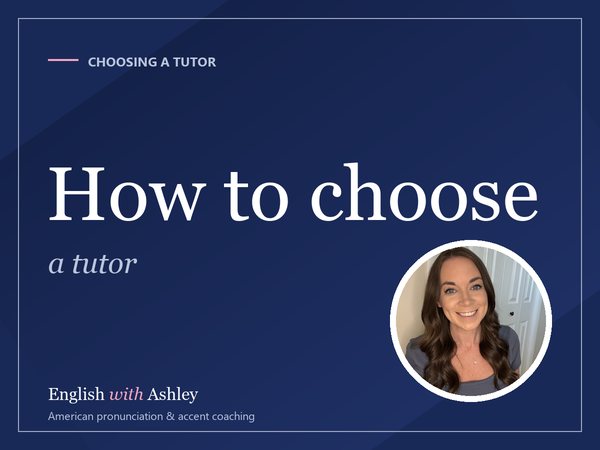 How to Choose an Online English Tutor (A Checklist From a Tutor)10 min read
 How Much Does Accent Reduction Coaching Cost in 2026?9 min read
 Is Accent Reduction Worth It? What Actually Changes (and What Doesn't)9 min readAll articles
  Glottal T | 5 Minute American English Pronunciation PracticePractice video
 Flap T | 2 Minute American English Pronunciation PracticePractice video
 P vs B | 4 minute English Pronunciation PracticePractice videoAll videos
  Work with AshleyBook your first lesson50 minutes, one-on-one, $25. Live calendar in your timezone.Book now
By Ashley Curry · 10 min read · Updated September 18, 2026
Work with AshleyBook your first lesson50 minutes, one-on-one, $25. Live calendar in your timezone.Book now
By Ashley Curry · 10 min read · Updated September 18, 2026
Most people choose an online English tutor the wrong way round. They look at the price and the star rating first, and only find out after five lessons that the tutor never corrects them. Here is how to choose an online English tutor in the order that actually predicts results.
Start with your goal, not the tutor list. If you want clearer pronunciation, you need a tutor who can hear your specific errors and explain the mouth mechanics behind them. If you want grammar or exam skills, you need structure and homework. Then check four things: the tutor's credentials and accent match your goal, their lessons have a repeatable plan, their cancellation and pricing rules are written down, and the first lesson ends with a diagnosis and a plan, not just a pleasant chat. Expect to pay $15 to $60 an hour on marketplaces and $25 to $80 direct.
I have taught more than 1,500 online lessons, and the students who improve fastest all arrive with a sentence like this: "I get asked to repeat myself on calls, and I want that to stop within three months." The students who drift arrive with "I want to improve my English." Both are honest, but only the first one lets a tutor build a plan.
Write one sentence that names the situation, the problem and the deadline. Some real examples from my lessons:
Now you know what kind of tutor you need. Pronunciation and speaking confidence need a tutor with a clear accent you want to copy and the ability to explain where the tongue goes. Exam prep needs someone who knows the band descriptors. Grammar needs patience and a system. A single tutor rarely does all three at the top level.
Native or fluent is the next filter. A native speaker is the right choice when your goal is accent, natural phrasing or sounding comfortable in American workplaces. You cannot copy a model you never hear, and a native tutor gives you that model for 50 minutes at a time. A fluent non-native tutor can be the better choice when you are stuck on grammar and want it explained in your own language, or when you want someone who remembers what it felt like to learn.
I am a native speaker with a neutral American accent, and I also spent years learning German to B1 level. I know how frustrating it is to hear a sound and not be able to make it. So my answer is not "always pick native". It is "pick native if you are paying for pronunciation, and pick the better teacher for everything else". I wrote a longer, fairer comparison in native or non-native English tutor: which is better for you.
A TEFL, CELTA or similar certificate proves the tutor has studied how to structure a lesson, how to give feedback and how to grade language for a learner's level. It does not prove they are good at it. A university degree proves they can research, read and write at a high level. It does not prove they can teach.
So read credentials as a floor, not a ceiling. Here is what I would ask for at each level:
| Signal | What it tells you | What it does not tell you |
|---|---|---|
| TEFL / CELTA | Knows lesson structure and error correction methods | Whether they use them in every lesson |
| University degree | Strong reading, writing and explanation skills | Anything about accent or speaking practice |
| Rating of 4.9 or 5.0 | Students felt comfortable and came back | What the students' level was, or what they achieved |
| Own videos or recordings | You can hear the accent and the teaching style before paying | Nothing, this one is pure upside |
The last row matters more than people think. If a tutor has short videos on YouTube, watch three. You will know in five minutes whether you can listen to that voice for 50 minutes a week, whether the explanations are concrete, and whether the accent is the one you want to build.
"Ashley is so patient" is nice to read, but it does not help you choose. Look for reviews that contain a verb describing what changed. "She corrected my TH sound and explained why my tongue was in the wrong place." "He gave me homework after every lesson and checked it." "My colleagues stopped asking me to repeat numbers." Those are outcomes.
Also look at who is writing. If every review is from a beginner and you are B2, the tutor may be excellent for beginners and bored or unprepared for you. I only teach adults at B1 and above, and I say so on my profile. A tutor who defines who they are not for usually knows exactly who they are for.
A trial lesson, paid or free, is a diagnostic appointment. A good one does not just chat about your weekend. Here is what mine includes, and what I would expect from any serious tutor:
/θ/ and /ð/ in think and this, the American R in work, the vowel in ship versus sheep, word stress in develop and economy.If you get all five, the tutor is worth a package. If the trial was pleasant but you cannot say what you learned, keep looking. I explain how I run mine, and why it is $25 rather than free, in what to expect from a trial lesson with an English tutor.
You can rule out many tutors from their profile alone. These are the patterns I would walk away from:
Online English lessons run from about $15 to $60 an hour on the big marketplaces, and from about $25 to $80 an hour when you book a private tutor directly. At $15 you often get a conversation partner with no plan. At $60 you should get a specialist with a diagnosis, homework and tracking.
One thing most students do not know: marketplaces take a commission from the tutor, typically 18 to 33 percent. So a $30 lesson on a platform may leave the tutor with $20 to $25, and many tutors raise their platform price to compensate. Booking directly usually means either a lower price for you, or more of your money reaching the person actually teaching you. I broke down the trade-offs, including payment protection and cancellation rules, in private English tutor vs Preply or italki.
For reference, my own pricing is written on one page: a first lesson is $25, a single lesson is $30, and packs bring that down to $23 a lesson for 30 lessons. Monthly plans run from $108 for one lesson a week to $288 for three. Every lesson is 50 minutes in my own online classroom with video, chat and shared notes, with free rescheduling up to 24 hours before. It is all on the pricing section, because a tutor who hides the price is usually about to negotiate it upward.
The real cost calculation is lessons needed multiplied by price per lesson. A $20 tutor who needs 40 lessons to get you to your goal costs $800. A $30 tutor who gets you there in 20 costs $600 and saves you ten weeks. Judge on the plan, not the hourly rate.
Copy this into your notes and check each item before you pay for more than one lesson.
| Check | Pass looks like |
|---|---|
| My goal in one sentence | Situation, problem and deadline written down |
| Accent matches my target | I have heard the tutor speak for at least five minutes |
| Specialization | Profile names a level and a focus, and says who it is not for |
| Credentials | Teaching certificate or degree, plus real lesson volume |
| Reviews | At least three describe a concrete change, from students near my level |
| Trial lesson | Named errors, one immediate fix, a plan with numbers |
| Correction method | Tutor explained how and when they will stop me |
| Price | Written on a page, with package and monthly options |
| Cancellation | Free up to 24 hours before, in writing |
| Logistics | Calendar in my timezone, reminders 24 h and 1 h before, shared notes |
Monday: write your one-sentence goal. Tuesday: shortlist three tutors whose voice you have actually heard. Wednesday: send each of them the same two questions, "how will you correct my mistakes?" and "what would my first month look like?", and compare the answers. By Friday, book one trial with the tutor whose answers were most specific. If you want to see how I answer those questions in a real lesson, you can book a first lesson for $25 and judge me against the checklist above.
Look for a tutor who states a minimum level and works mainly with adults, because advanced learners need error correction and precision, not more basic input. Ask how they handle fossilized mistakes, the errors you have made for years without noticing. A good answer names a method, for example recording you, isolating the sound or structure, and drilling it in real sentences.
No. A native speaker is the better choice for accent, natural phrasing and cultural fluency, because you need an authentic model to copy. For grammar explanations or early confidence, a strong non-native tutor who shares your first language can be better. Choose by your goal, then by teaching skill.
Trust the content, not the price. A free trial is often 25 minutes of chat with no diagnosis, because the tutor is protecting their time. A low-priced paid first lesson, like my $25 one, is usually a full 50 minutes with an assessment and a plan. Judge any trial by whether you can name what you learned afterwards.
Marketplace tutors typically charge $15 to $60 an hour, private tutors booked directly $25 to $80. Platforms take 18 to 33 percent from the tutor, which pushes prices up. Compare total cost to reach your goal, not the hourly rate: a specialist who needs fewer lessons is often cheaper overall.
A profile that claims to teach every level, every age and every exam. Specialists get faster results because they see the same problems every week and know the fixes. The second biggest red flag is no sample of the tutor's voice when you are paying for pronunciation.
One trial, then a pack of five. Five lessons is enough to see whether corrections are sticking and whether you are doing the homework. Only move to a monthly plan once you know you will keep the schedule.
Accent coaching runs from $15 an hour to $5,000 a program. Here is what each price buys, and how many hours most adults actually need.
Accent reduction is worth it when being misunderstood costs you something. Here is what changes in 10 to 20 lessons, and what stays.
The five blocks of a 50-minute pronunciation lesson, with minutes, drills and what you take home, plus how the first diagnostic lesson differs.
Private American English coaching with Ashley Curry: pronunciation, accent and confidence, built around your goals.