How to Prepare for Your First Online English Lesson
Five written answers, a six-point tech check and one sentence to say in the first minute: everything a first online English lesson needs from you.
 How to Choose an Online English Tutor (A Checklist From a Tutor)10 min read
 How Much Does Accent Reduction Coaching Cost in 2026?9 min read
 Is Accent Reduction Worth It? What Actually Changes (and What Doesn't)9 min readAll articles
  Glottal T | 5 Minute American English Pronunciation PracticePractice video
 Flap T | 2 Minute American English Pronunciation PracticePractice video
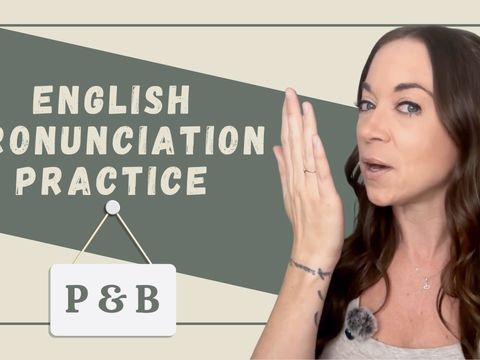 P vs B | 4 minute English Pronunciation PracticePractice videoAll videos
  Work with AshleyBook your first lesson50 minutes, one-on-one, $25. Live calendar in your timezone.Book now
By Ashley Curry · 9 min read · Updated September 2, 2026
Work with AshleyBook your first lesson50 minutes, one-on-one, $25. Live calendar in your timezone.Book now
By Ashley Curry · 9 min read · Updated September 2, 2026
You can build most of your speaking fluency alone, in your kitchen, without a partner. The condition is that you speak out loud, you record it, and you know what each exercise is for.
Here is how to practice English speaking alone in a way that actually changes your speech: talk out loud for at least 15 minutes a day using a mix of shadowing, narrating what you are doing, reading aloud with marked stress, answering recorded questions, and retelling something you just heard. Record one exercise a day and listen back. Solo practice builds fluency and automatic pronunciation. It cannot tell you which sounds are wrong, so pair it with feedback from a tutor or a native speaker at least once a week.
Most "speaking practice" I hear about from new students is silent. They watch videos, they read articles, they do grammar apps, and they wonder why speaking has not improved. Speaking is a physical skill. Your tongue, lips and jaw have to make American sounds thousands of times before they become automatic, and reading silently does not move them once.
So the first rule is simple: if your mouth is not moving, it is not speaking practice. It may still be useful, but count it as listening or reading. The second rule is that you need a recording. You cannot judge your own speech while you are producing it, because your attention is on the meaning. Thirty seconds of playback tells you more than ten minutes of talking.
About feeling silly: everyone does, for about a week. Talking to yourself in a foreign language in an empty room feels strange until it does not. I did it in German on my walks, and the first few days I checked over my shoulder every time. By the second week it was just part of the walk. Give it that long.
You do not need all nine. Pick three or four that match your goal and rotate them. The table gives the summary, and the sections below explain how to do each one properly.
| Exercise | Minutes | Trains |
|---|---|---|
| 1. Shadowing | 15 | Rhythm, stress, linking, speed |
| 2. Narrating your day | 5-10 | Fluency, everyday vocabulary |
| 3. Reading aloud with marked stress | 10 | Word stress, sentence stress, clear consonants |
| 4. Recorded question and answer | 10 | Spontaneous speech, interview and meeting answers |
| 5. Retelling | 5 | Summarizing, connectors, memory for chunks |
| 6. Minimal-pair drills | 5 | One target sound at a time |
| 7. The one-minute explanation | 5 | Precision, explaining your work |
| 8. Voice messages | 2-5 | Real audience, low pressure |
| 9. Talking to an AI in voice mode | 10 | Conversation turns, vocabulary |
Listen to 30 seconds of clear American speech and speak with it, half a beat behind, copying the melody. This is the exercise with the biggest effect on accent, and it deserves its own instructions, so I wrote a full step-by-step shadowing guide. If you only do one thing from this list, do this.
While you cook, walk or tidy up, describe what you are doing out loud in real time: "I'm putting the pan on the stove. The oil's getting hot. I should have chopped the onion first." This builds fluency in the vocabulary you actually need, and it forces contractions and natural chunks like should have, which most learners avoid in careful speech. When you cannot find a word, say it in your language, keep going, and look it up afterwards.
Take a paragraph of an article, and before you read it, underline the one or two most important words in each sentence. Then read it aloud, giving those words extra time and pitch and squeezing the words between them. Reading aloud without marking stress just rehearses flat, even rhythm, which is the opposite of what you want. Record the second reading and listen for whether the underlined words actually stand out.
Write ten questions you expect to be asked at work or in an interview: "Can you walk me through your current project?", "What would you do differently?", "Why are you leaving your current role?" Record yourself asking them with a short pause after each. Then play the recording and answer each question out loud, in real time, for 45 to 60 seconds. This is the closest you can get to spontaneous speech alone, and it is the exercise my students preparing for interviews get the most from.
Listen to a two-minute podcast segment or watch a short video, then explain it out loud in one minute to an imaginary colleague. Start with "So basically..." and end with your opinion. This trains connectors (which means, the point is, even though) and it recycles vocabulary from the source while it is still fresh. If you struggle to remember words when speaking, this exercise plus a simple review system, which I describe in how to remember English vocabulary, is the fix.
Five minutes on one sound contrast: ship/sheep, think/sink, right/light, bad/bed. Say each pair slowly, then fast, then inside a sentence: "I think the ship is late." The trap here is drilling the wrong mouth position for a month. Check the position first: for TH, tongue tip visible between the teeth; for the vowel in sheep, lips spread wide and tongue high; for ship, everything relaxed. If you are not sure whether your version is right, this is the exercise to save for a lesson, because nobody can hear their own errors in the sounds their first language does not have.
Explain one thing from your job to a beginner in exactly one minute: what an API is, how a mortgage works, what your team did last sprint. Time it. Under a minute means you skipped steps; over means you rambled. My tech and finance students do this daily before standups and demos, and it is the fastest way to stop translating in your head, because the content is already in your head in the right order.
Send a voice message in English instead of a text: to a colleague, a language partner, or a friend who is also learning. It is real communication with a real listener, but you can re-record if the first take falls apart, so the pressure is low. Students who are nervous about speaking often start here, and I cover why it works so well in how speaking confidence is built.
Voice conversations with ChatGPT or a similar tool give you unlimited conversation turns, and they are good for vocabulary and for practicing a role-play like a difficult customer call. Two warnings. First, the AI understands your accent even when a human would not, so it gives you no signal about clarity. Second, it cannot see your mouth or hear that your R is close but not right. I go through what these tools do well and where they fail in using ChatGPT to learn English. Use them for fluency, not for pronunciation.
Fifteen to twenty minutes a day, six days a week, is enough to change how you speak within a couple of months. Here is a plan I give students who work full time.
| Day | Plan (about 20 minutes) |
|---|---|
| Monday | Shadowing 15 min + narrate one task 5 min |
| Tuesday | Reading aloud with stress 10 min + minimal pairs 5 min + one-minute explanation |
| Wednesday | Shadowing 15 min + one voice message |
| Thursday | Recorded question and answer 10 min + retelling 5 min |
| Friday | Shadowing 15 min + listen to Monday's and today's recordings back to back |
| Saturday | AI voice conversation 10 min on a topic from your week, or a longer narration |
| Sunday | Rest, or listen to your recordings and pick next week's target sound |
Two rules keep this alive. Attach each session to something you already do (the kettle, the commute, the walk), and keep the same target sound for the whole week. Changing focus every day feels productive and produces nothing.
I want to be direct about the limits, because I have watched students practice hard for a year and improve very little, and the reason was always the same. Practice makes permanent, not perfect. If your TH is really a D, every solo drill makes the D stronger. If you stress DEvelop instead of deVELop, reading aloud rehearses the wrong stress a hundred times a week.
You cannot hear these errors yourself, because your brain filters your speech through the sounds of your first language. This is not a lack of talent; it is how ears work. The only reliable fix is someone who hears the error, shows you the correct position, and checks it again a week later. That is why the first thing I do in a first lesson is record a student reading and talking, then play it back and point to the exact words. Most students are surprised by what they hear, and from that moment their solo practice is aimed at the right targets.
So the combination that works is daily solo practice plus weekly feedback. Solo practice gives you volume; feedback gives you direction. Either one alone is slow. If you want to know what your solo practice should focus on, book a first lesson for $25, and you will leave with a recording of yourself, your three highest-priority errors, and a plan for the exercises above. You can see the lesson options on the pricing page.
Tonight, record yourself talking for one minute about what you did today. Do not prepare it. Save the file with the date. Then choose three exercises from the list above: shadowing plus two others that match your goal. Do them for 20 minutes a day until Friday, and on Friday record the same one-minute talk again. Listen to both. You will hear more fluency already, and you will also hear one or two sounds that did not change. Those are the ones to bring to a lesson.
Talk to a recording. Shadow native audio, narrate what you are doing, answer recorded questions, and send voice messages. Speaking practice is about moving your mouth and hearing the result, not about having a partner in the room. A partner is useful later, for testing whether you are understood.
Fifteen to twenty minutes of speaking out loud, six days a week, produces clear change within two months. Five minutes a day is better than nothing but progress is slow. Two hours once a week is worse than 15 minutes daily, because pronunciation is a motor habit and habits need frequent repetition.
Both on the same day, and listening first for a few minutes. You copy what you can hear, so a short active listening session with a transcript before shadowing makes the shadowing better. I explain the routine in my article on English listening practice.
It is effective for fluency and for automating vocabulary and pronunciation you already know is correct. It is not effective for finding errors, because you cannot hear the sounds your first language does not have. Use it for volume and use a tutor for direction.
Record one exercise a day, one to two minutes long, and listen to it once immediately. Then keep the recordings and compare one from this week with one from a month ago. The immediate playback catches today's slips; the monthly comparison shows you the progress you cannot feel day to day.
Five written answers, a six-point tech check and one sentence to say in the first minute: everything a first online English lesson needs from you.
What a real trial lesson contains, why mine costs $25 instead of nothing, and an eight-point scorecard for judging any tutor after one hour.
The rule, the exceptions, the spelling traps and a drill list for the sound that makes water, better and city sound American instead of textbook.
Private American English coaching with Ashley Curry: pronunciation, accent and confidence, built around your goals.