American vs British Pronunciation: The 10 Differences That Matter Most
The ten pronunciation differences between American and British English that actually matter, with examples, and how to choose one accent and stay consistent.
 How to Choose an Online English Tutor (A Checklist From a Tutor)10 min read
 How Much Does Accent Reduction Coaching Cost in 2026?9 min read
 Is Accent Reduction Worth It? What Actually Changes (and What Doesn't)9 min readAll articles
  Glottal T | 5 Minute American English Pronunciation PracticePractice video
 Flap T | 2 Minute American English Pronunciation PracticePractice video
 P vs B | 4 minute English Pronunciation PracticePractice videoAll videos
  Work with AshleyBook your first lesson50 minutes, one-on-one, $25. Live calendar in your timezone.Book now
By Ashley Curry · 10 min read · Updated July 20, 2026
Work with AshleyBook your first lesson50 minutes, one-on-one, $25. Live calendar in your timezone.Book now
By Ashley Curry · 10 min read · Updated July 20, 2026
You do not need more travel vocabulary. You need about 40 short exchanges that you can say out loud, fast, without thinking, while a tired agent behind a counter waits for you.
English for travel speaking comes down to a small set of repeated situations: check-in, security, immigration, taxis, hotel problems, ordering, paying, asking for directions, pharmacies and quick small talk. Practice the 40 exchanges below out loud, not silently, in the two weeks before your trip. Focus on the three pronunciation points that cause most travel misunderstandings: stress in numbers, the vowel in can versus can't, and clear final consonants. If you can say each phrase in one breath at normal speed, you are ready.
Most of my students who ask for travel lessons already know every word they need. They can write "Could you tell me where the baggage claim is?" without a mistake. Then they land in Atlanta, the agent says "Wheryaheadedtoday?" in one word, and their mind goes blank.
The problem is not vocabulary. It is three things: you have never said the phrase out loud under time pressure, you have never heard the reduced version of the question, and you are not sure your pronunciation will land the first time. That is why I built my travel lessons around situations, not word lists. Each situation is a tiny script that you rehearse until it is automatic, and then we swap in the fast native version of what you will hear back.
Here is the full list. Print it, tick off the ones you can already do in one breath, and work on the rest. Each group has eight situations, and the sections below give you the phrases and the pronunciation note for each group.
| Where | Situations |
|---|---|
| Airport and plane | Check-in, bag drop, security, boarding, seat problem, drinks on board, immigration, customs |
| Getting around | Taxi or rideshare, bus or train ticket, asking directions, confirming you are on the right train, renting a car, filling up gas, parking, a delayed connection |
| Hotel | Checking in, early check-in, a room problem, asking for extra items, wifi, breakfast hours, late checkout, a wrong charge on the bill |
| Food and shops | Getting a table, ordering, dietary needs, changing an order, asking for the check, tipping, buying something, returning something |
| Problems and health | Lost bag, lost phone or wallet, pharmacy, describing a symptom, calling for help, police report, missed flight, a card that will not work |
The agent's questions are short and reduced. Learn the reduced form on the left so you recognize it, and the answer on the right so you can say it without a pause.
CARE-ee-on with the stress on the first syllable.thir-TEEN and THIR-ty.SEE, not SAY.ENNYthing-ta-DRINK.C as in Charlie.FOR-ty and FOUR clearly different in length.The trap in this group is can and can't. "You can park here" and "you can't park here" have opposite meanings and nearly identical Ts. Americans hear the difference in the vowel and the stress, not the T. I explain the mechanism in can vs can't in American English, and I check it first in every travel lesson because a wrong guess here costs you a parking ticket.
At the hotel, eight more exchanges cover every stay:
four-twelve, not "four hundred and twelve."WHY-fy.Restaurants are where my students report the most embarrassment, because the server is fast, the menu has words like sourdough and jalapeño, and there is a line behind you.
uh-LER-jik.ruh-SEET; the P is silent.A small thing that changes how servers treat you: say "Can I get a wadder?" with the flap T. It marks you as someone who has heard real American speech, and servers slow down and smile more. Students like Cesar tell me this one word did more for their restaurant confidence than a whole vocabulary list.
These are the situations where clear pronunciation matters most, because stress is high and the person helping you may be on the phone.
TAG with a clear final G.Final consonants are the issue here. Tag, left, theft, declined: many of my students, especially speakers of Spanish, Portuguese, Vietnamese and Thai, drop the last sound of a word. In a quiet lesson it is a small thing. On a phone with a dispatcher it is the difference between being understood and repeating yourself three times.
If you only have time to fix three things, fix these. They come up in almost every one of the 40 situations.
thir-TEEN vs THIR-ty, fif-TEEN vs FIF-ty. Gate numbers, room numbers, prices, times. Get this wrong and you end up at the wrong gate.On the listening side, train connected speech: "Did you" becomes didja, "want to" becomes wanna, "What are you" becomes whaddya. You cannot hear them in your own head, which is why in lessons I say the reduced version first and only show the written form after you have guessed it.
Then there is the small talk that runs through all 40. The driver, the server and the person next to you on the plane will ask "So where are you visiting from?" and expect a friendly two-sentence answer plus a question back. Prepare three lines: an answer like "I'm from Lisbon, first time in Texas, it's a lot bigger than I expected. Are you from here?", an opener like "How's your day going?" when you arrive at a counter, and "Have a good one!" as you leave. My guide to small talk in American English has more openers and exits, and if talking to strangers makes you tense, my article on fear of speaking English explains why short scripted exchanges like these are the fastest way through it.
Pick ten situations from the table, the ten you are most likely to face on day one. Say each answer out loud five times, standing up, at the speed you would use with a real person. Record yourself on your phone and listen for two things: did every number have the right stress, and did every word end with its final sound. Tomorrow, take the next ten. In four days you will have covered all 40.
If you want someone to play the tired gate agent, the fast server and the driver, that is exactly what a travel lesson with me is. We run the situations live, I feed you the reduced questions at real speed, and I stop you only on the pronunciation that would actually cause a problem. You can book a first lesson for $25, and if you have a trip coming up, two or three lessons in the week before departure is usually enough. Lesson and pack prices are in the pricing section.
For a B1 or B2 speaker, two weeks of ten minutes a day covers all 40 situations. The point is repetition out loud, not learning new words. If you can say each phrase in one breath without pausing to think, you have done enough.
Match the country. In the US say check, round trip, restroom, gas and pharmacy. In the UK say bill, return, toilet, petrol and chemist. Mixing them is not a disaster, but using the local word gets you a faster answer.
Say "Sorry, could you say that slower?" rather than "Sorry?" again. Asking for slower speech works; asking for repetition usually gets you the same fast sentence at the same speed. You can also repeat the part you did understand: "Gate B, and then?"
No. Americans repeat themselves for each other constantly and nobody minds. What reads as odd is silence or a nod when you did not understand. A quick "Sorry, one more time?" with a smile is completely normal.
No. You need clear word stress, a clear can/can't contrast and full final consonants. Your accent can stay yours. Research on intelligibility (Munro and Derwing) is consistent on this: being understood depends far more on stress and rhythm than on sounding native.
The ten pronunciation differences between American and British English that actually matter, with examples, and how to choose one accent and stay consistent.
What a neutral American accent actually is, how it differs from regional speech, and the realistic version of it that an adult learner should aim for.
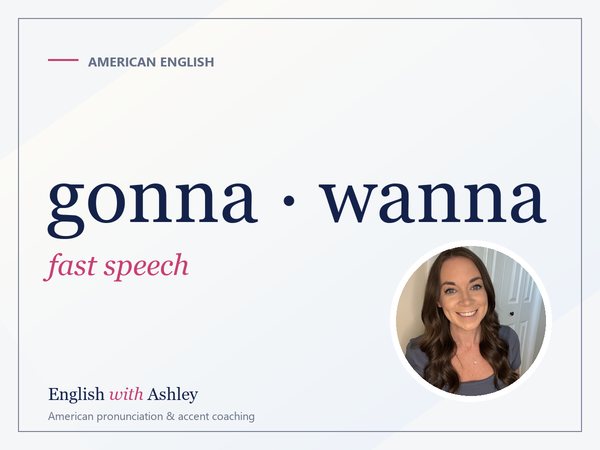
Americans are not speaking fast; they are shrinking the unimportant words. Learn the reductions and stress pattern and the speed problem disappears.
Private American English coaching with Ashley Curry: pronunciation, accent and confidence, built around your goals.